
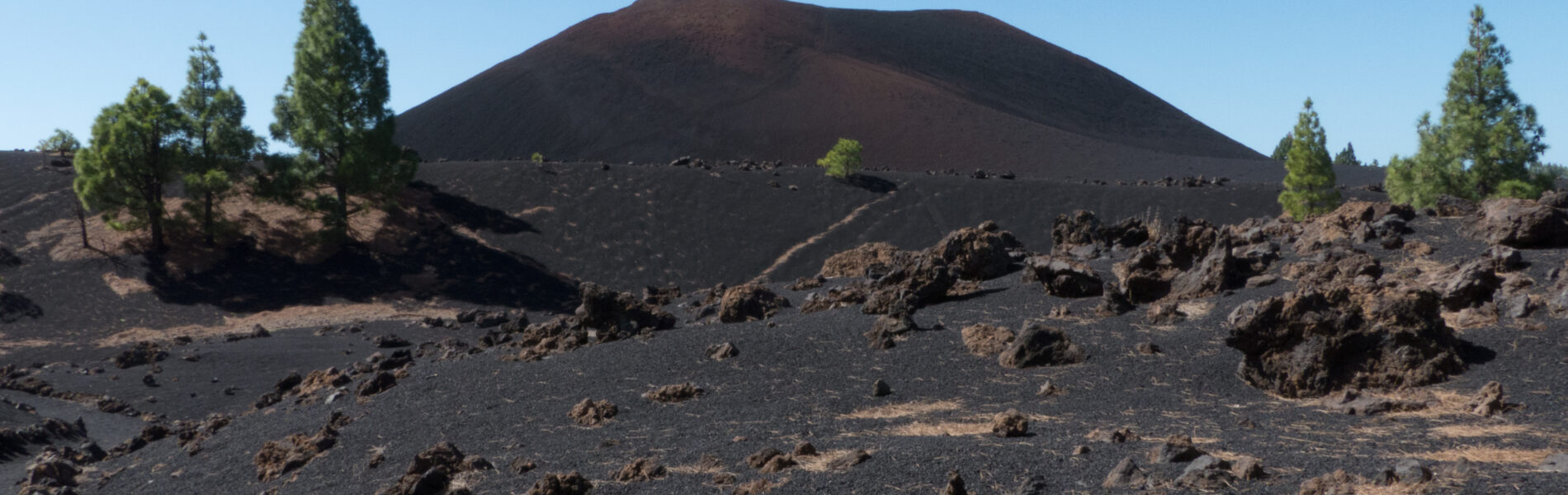
Chinyero Volcano is a dark volcanic cone on Tenerife’s western flank, formed during the island’s last major eruption in 1909. Surrounded by pine forest and extensive lava fields, it remains one of the most accessible volcanic landscapes in the Santiago del Teide region.
Chinyero Volcano rises from the western slopes of Tenerife as a dark, ash‑covered cone formed during the 1909 eruption. The event produced extensive lava flows that spread across the Santiago del Teide region, creating a landscape of fractured rock, black terrain and scattered pine forest that remains largely unchanged more than a century later.
The cone itself is modest in height but visually striking. Its slopes are covered in loose volcanic material, and the surrounding lava fields form a natural amphitheatre of jagged formations and cooled basalt. The contrast between black terrain and the bright needles of Canary Island pine gives the area a distinctive colour palette.
A circular walking route encircles the cone, offering close views of the lava flows and the geological structures created during the eruption. The path moves between open lava plains and sections of forest, revealing how vegetation has gradually reclaimed parts of the terrain while other areas remain stark and exposed.
Light plays a strong role in the atmosphere around Chinyero. Morning sun highlights the textures of the lava, while afternoon cloud from the western massif can soften the landscape, creating alternating bands of brightness and shadow across the cone.
Chinyero Volcano remains one of Tenerife’s most accessible volcanic environments — a clear, readable landscape where the effects of a historic eruption are visible in every direction.
🏛 Similar places

🏨 Hotels nearby
No hotels found.